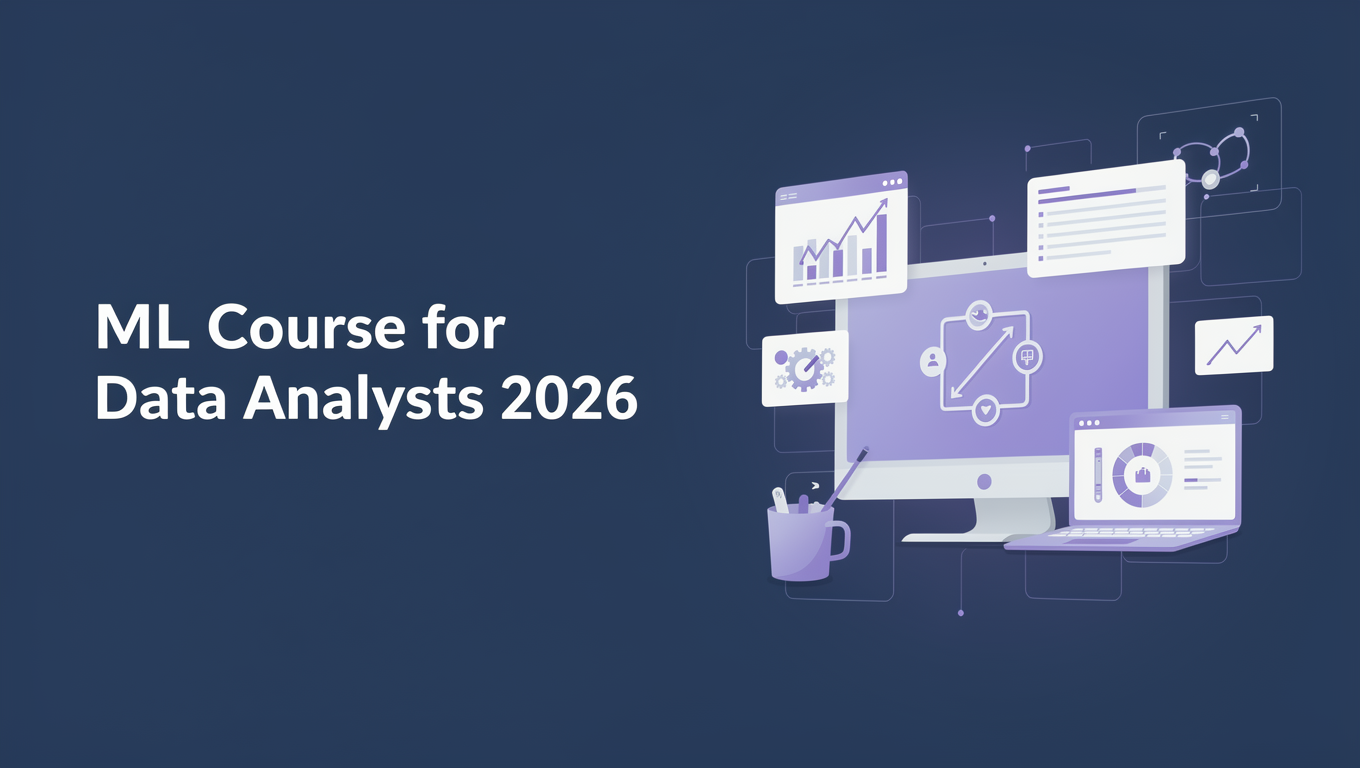
Data analysts increasingly need machine learning skills to extract deeper insights from complex datasets and advance their careers. The right ML course can transform your analytical capabilities, helping you build predictive models, automate data processing, and deliver more sophisticated business intelligence.
This roundup examines the best machine learning courses specifically designed for data analysts in 2026, focusing on practical applications and industry-relevant skills.
Essential ML Skills for Data Analysts
Modern data analysts require a specific subset of machine learning competencies that differ from those needed by dedicated data scientists or ML engineers. Key areas include:
- Supervised learning algorithms for classification and regression tasks
- Data preprocessing and feature engineering techniques
- Model evaluation and validation methods
- Statistical foundations underlying ML approaches
- Business application of ML insights
Understanding these fundamentals helps analysts choose appropriate algorithms for business problems and communicate results effectively to stakeholders.
Top ML Courses for Data Analysts
Comprehensive Foundation Programmes
Machine Learning for Data Analysis Specialisation provides thorough coverage of core ML concepts specifically tailored for analysts. The programme covers decision trees, clustering algorithms, and regression techniques with practical Python implementations.
Students learn to apply cross-validation techniques to prevent overfitting and understand when different algorithms perform optimally. The course emphasises real-world applications over theoretical complexity.
Data Science: Building Machine Learning Models from Harvard University focuses on practical model construction. This programme teaches analysts how to evaluate model performance, select appropriate algorithms, and implement solutions using industry-standard tools.
Integrated Analytics Programmes
Professional Certificate in Advanced Analytics with AI, ML, and Data Science combines traditional analytics with modern ML techniques. This comprehensive approach helps analysts understand how machine learning fits within broader data workflows.
The programme covers data science fundamentals alongside advanced AI concepts, making it ideal for analysts seeking to expand their technical toolkit whilst maintaining focus on business applications.
Platform-Specific Training
Several platforms offer curated ML content for data analysts. AIU.ac’s extensive course library includes over 6,000 courses from Pluralsight, 140+ from Educative, and additional providers, offering comprehensive coverage of ML topics for analysts at different skill levels.
These curated programmes often provide structured learning paths that progress from basic statistical concepts to advanced ML implementations, ensuring analysts build solid foundations before tackling complex algorithms.
Practical Applications and Tools
Python for ML Implementation
Most quality ML courses for data analysts emphasise Python programming, covering essential libraries like scikit-learn, pandas, and NumPy. Analysts learn to implement algorithms without getting lost in low-level mathematical details.
Courses typically cover data manipulation, visualisation, and model deployment within familiar analytical workflows. This approach helps analysts integrate ML techniques into existing processes rather than requiring complete workflow overhauls.
Statistical Foundations
Strong ML courses for analysts emphasise statistical understanding over algorithmic complexity. Students learn when to apply different techniques, how to interpret results, and how to communicate findings to non-technical stakeholders.
This statistical grounding proves crucial when analysts need to explain model behaviour, validate results, or troubleshoot unexpected outcomes in production environments.
Industry-Specific Applications
Business Intelligence Enhancement
Modern ML courses teach analysts how to enhance traditional BI reporting with predictive capabilities. Students learn to build forecasting models, detect anomalies in business metrics, and automate routine analytical tasks.
These applications directly impact daily analytical work, making ML training immediately valuable for practising analysts.
Customer Analytics
Specialised courses cover customer segmentation, churn prediction, and recommendation systems. These applications represent common use cases where analysts can immediately apply ML techniques to generate business value.
Understanding these specific applications helps analysts identify opportunities within their organisations and build relevant technical skills.
Career Development Pathways
Certification and Credentials
Professional certificates from recognised institutions provide credible validation of ML skills. Google Data Analytics Professional Certificate and IBM Data Analyst Professional Certificate both include ML components relevant to analytical roles.
These credentials help analysts demonstrate competency to employers whilst maintaining focus on analytical rather than engineering responsibilities.
Progression to Advanced Roles
ML training opens pathways to senior analytical positions, data science roles, and specialised positions in business intelligence. Comprehensive course offerings allow analysts to build skills progressively, moving from basic ML concepts to advanced implementations as their careers develop.
Understanding ML operations (MLOps) becomes increasingly important as analysts work with production systems. Our complete MLOps guide provides detailed information about operational considerations for ML implementations.
Course Selection Criteria
Practical Focus
The best ML courses for data analysts emphasise practical application over theoretical depth. Look for programmes that include real datasets, business case studies, and hands-on projects that mirror actual analytical work.
Courses should teach students to solve business problems using ML techniques rather than focusing primarily on algorithmic implementation details.
Tool Integration
Quality programmes demonstrate how ML techniques integrate with existing analytical tools and workflows. Students should learn to implement solutions using familiar platforms and export results to standard business intelligence systems.
This integration focus ensures ML skills complement rather than replace existing analytical capabilities.
Support and Community
Strong courses provide ongoing support through forums, mentorship, or peer networks. Learning ML concepts can be challenging, and access to experienced practitioners helps students overcome obstacles and maintain momentum.
Community aspects also provide networking opportunities and exposure to different industry applications of ML techniques.
Implementation Strategies
Gradual Skill Building
Successful ML adoption by data analysts typically follows a gradual progression. Start with simple algorithms like linear regression and decision trees before advancing to ensemble methods or neural networks.
This approach allows analysts to build confidence whilst delivering immediate value to their organisations through improved analytical capabilities.
Project-Based Learning
The most effective ML courses for analysts include substantial project components. Students should complete end-to-end implementations that include data collection, preprocessing, model building, validation, and results presentation.
These comprehensive projects prepare analysts for real-world ML implementations and provide portfolio pieces for career advancement.
Frequently Asked Questions
How long does it take to learn ML skills as a data analyst?
Most data analysts can develop functional ML skills within 3-6 months of focused study. Analysts with strong statistical backgrounds often progress faster, whilst those needing to develop programming skills may require additional time. Consistent practice with real datasets accelerates learning significantly.
Do I need advanced mathematics to use ML as a data analyst?
While deep mathematical understanding helps, data analysts can effectively use ML techniques with solid statistical foundations and basic calculus knowledge. Modern tools and libraries handle complex mathematical implementations, allowing analysts to focus on problem-solving and interpretation rather than algorithmic details.
Which programming language should data analysts learn for ML?
Python remains the most practical choice for data analysts learning ML. Its extensive library ecosystem, readable syntax, and strong community support make it ideal for analytical applications. R also provides excellent ML capabilities, particularly for statistical applications, but Python offers broader industry adoption.
How do ML skills change daily analytical work?
ML skills enable analysts to automate routine tasks, build predictive models, and extract insights from larger, more complex datasets. Analysts can create more sophisticated reports, identify patterns that traditional methods might miss, and provide forward-looking insights rather than purely historical analysis.
What’s the difference between ML for analysts versus data scientists?
Data analysts typically focus on applying established ML techniques to solve specific business problems, whilst data scientists often develop new algorithms or conduct extensive experimentation. Analysts emphasise practical application and business communication, whereas data scientists may work on more theoretical or research-oriented projects.