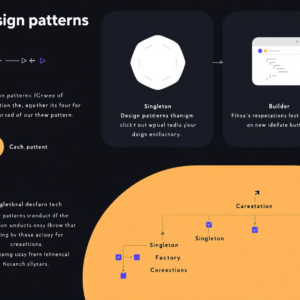

Grokking the Low Level Design Interview Using OOD Principles
This object oriented design course from Educative provides strategic preparation for technical interviews at leading technology companies. The 5-hour interactive programme focuses specifically on breaking down complex system design problems using established OOD principles and patterns. Students work through real-world scenarios commonly presented in interviews, learning to architect scalable systems whilst demonstrating solid object-oriented thinking. The browser-based format requires no software installation, allowing immediate access to coding environments and design exercises. With a 4.6 rating, this course bridges theoretical knowledge with practical interview performance, covering essential design patterns, SOLID principles, and system architecture decisions that interviewers expect candidates to articulate clearly.
Prepare for your object-oriented design interview with this strategic course. Ace your object-oriented design interview by breaking down complex problems..
Is Grokking the Low Level Design Interview Using OOD Principles Worth It in 2026?
This course is most valuable for mid-level software engineers preparing for senior or staff-level interviews at FAANG companies, scale-ups, and fintech firms where object-oriented design is still a core evaluation criterion. If you’re transitioning into backend or systems roles, or you’ve been coding for 2+ years but haven’t formally studied OOD patterns, you’ll find concrete, interview-ready frameworks here.
The honest caveat: this course focuses narrowly on low-level design (single-service, class-level architecture). If you’re interviewing for distributed systems roles, you’ll need supplementary material on microservices, eventual consistency, and network partitioning. The 5-hour duration also means it’s a primer, not a comprehensive deep-dive—you’ll still need to practise building systems end-to-end.
Our verdict: worth your time if you have a specific interview lined up or you’re systematically closing gaps in OOD knowledge. The interactive, browser-based format means zero setup friction, and Educative’s text-based approach suits people who learn by reading and coding simultaneously rather than watching videos. AIU.ac recommends this as part of a broader interview prep stack, paired with system design courses covering high-level architecture.
What You’ll Learn
- Design a parking lot system using SOLID principles, including vehicle hierarchy, payment processing, and spot allocation algorithms
- Implement the Strategy pattern to handle multiple discount types in an e-commerce checkout flow
- Build a hotel booking system with reservation management, room inventory, and cancellation policies using composition and inheritance
- Apply the Observer pattern to create a notification system that decouples event publishers from subscribers
- Design a library management system with member roles, book lending logic, and fine calculations using encapsulation
- Refactor tightly-coupled code into loosely-coupled modules using dependency injection and interface segregation
- Model a ride-sharing platform (Uber-style) with driver matching, fare calculation, and trip state management
- Construct a chess game engine with piece movement validation, board state management, and game rule enforcement
- Recognise when to use composition over inheritance and justify design choices in a technical interview setting
- Document your OOD decisions using UML diagrams and explain trade-offs between flexibility and complexity
What AIU.ac Found: What AIU.ac found: The course structure follows a problem-first methodology—each module presents a real interview question (e.g., ‘Design a parking lot’), walks through requirements gathering, then builds the solution incrementally using OOD principles. This mirrors actual interview dynamics better than abstract pattern lectures. The embedded code editor lets you write and test solutions immediately, reducing the friction between learning and practising.
Last verified: March 2026
Frequently Asked Questions
How long does Grokking the Low Level Design Interview Using OOD Principles take?
The course is approximately 5 hours of active learning. Most engineers complete it in 1–2 weeks studying 2–3 hours per week, though you may want additional time to practise building systems after finishing the core material.
Do I need to know Java or C++ before taking Grokking the Low Level Design Interview Using OOD Principles?
Yes, you should be comfortable with at least one object-oriented language. The course uses Java and C++ examples, so prior experience with classes, inheritance, and polymorphism is essential. If you’re coming from Python or JavaScript, you may find the syntax unfamiliar but the concepts transferable.
Is Grokking the Low Level Design Interview Using OOD Principles suitable for beginners?
No. This course assumes you’ve written production code and understand basic OOP concepts. Beginners should first complete a foundational OOP course before attempting this interview-focused material.
Will this course prepare me for high-level system design interviews?
Partially. This course covers low-level design (class structure, patterns, single-service architecture). For distributed systems, microservices, and infrastructure questions, you’ll need a separate high-level system design course.
Can I access Grokking the Low Level Design Interview Using OOD Principles on mobile?
Yes, Educative’s platform is browser-based and responsive. However, coding and designing on a small screen is cumbersome; a laptop or tablet is recommended for the best experience.