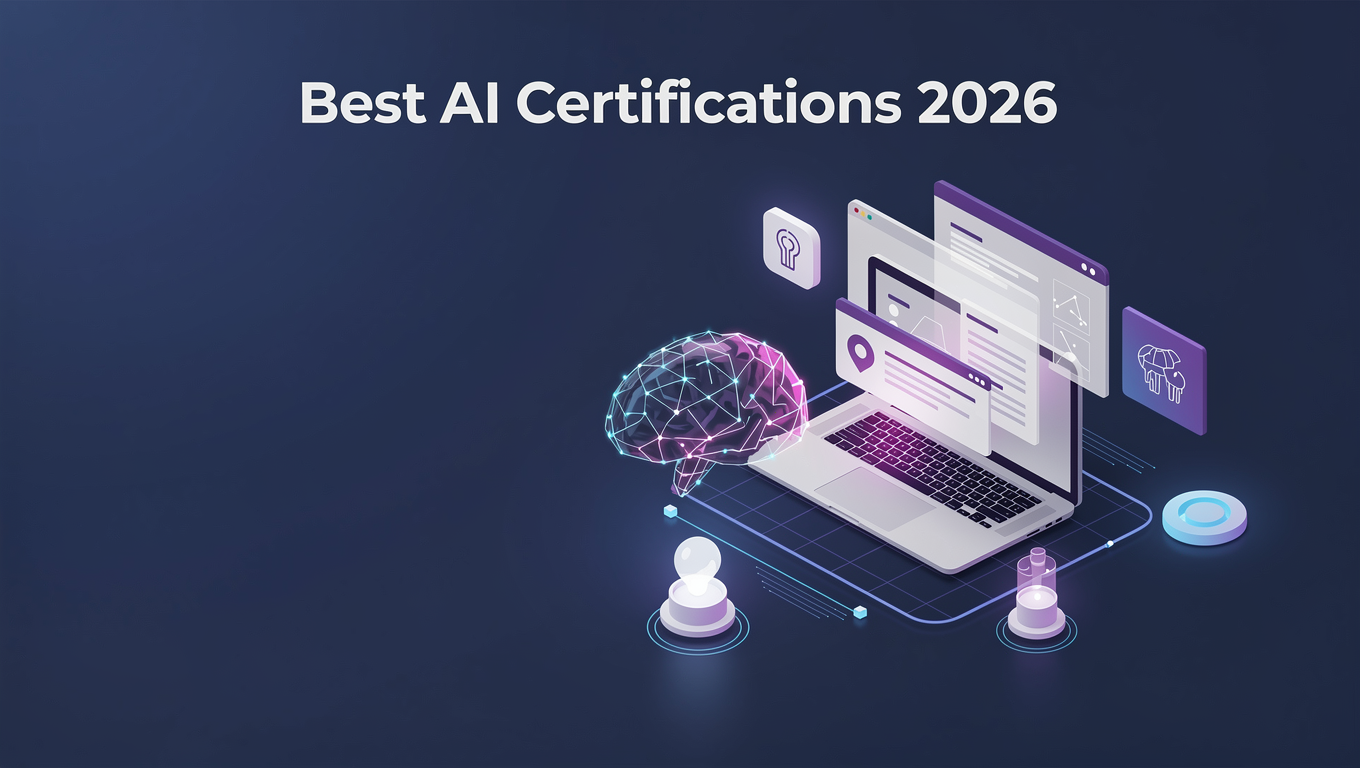
The artificial intelligence job market has exploded, with demand for AI professionals growing 74% year-over-year according to recent industry reports. Whether you’re switching careers or advancing in tech, the right AI certification can open doors to roles paying £60,000 to £150,000+ annually.
But here’s the challenge: not all AI certifications carry equal weight with employers. Some focus on outdated techniques, whilst others teach cutting-edge skills that companies desperately need. After reviewing dozens of programmes and speaking with hiring managers across the UK, I’ve identified the certifications that actually matter in 2026.
What Makes an AI Certification Worth Your Time
Before jumping into specific programmes, let’s establish what separates valuable certifications from marketing exercises. The best AI certifications share three characteristics:
- Industry recognition: Major employers know and respect the certification body
- Practical skills: You’ll work on real projects, not just memorise theory
- Current relevance: The curriculum reflects what companies use today, not what they used five years ago
The AI field moves incredibly fast. A certification in traditional machine learning might have been sufficient in 2020, but today’s roles often require expertise in generative AI, large language models, and responsible AI practices.
Top-Tier AI Certifications for 2026
AWS Machine Learning Engineer Associate
Amazon’s new certification replaces the retiring Machine Learning Specialty programme (which ends March 2026). This certification focuses on building and deploying ML solutions using AWS services like SageMaker, Bedrock, and Lambda.
Why it matters: AWS dominates cloud infrastructure, and most enterprise AI projects run on their platform. The certification covers both traditional ML and generative AI applications.
Best for: Software engineers, data scientists, and cloud professionals wanting to specialise in AI deployment
Time investment: 3-4 months with consistent study
Google Cloud Professional Machine Learning Engineer
Google’s certification emphasises end-to-end ML workflows, from data preparation through model deployment and monitoring. The 2026 version includes significant coverage of Vertex AI and generative AI tools.
Why it matters: Google invented many foundational AI technologies (Transformers, TensorFlow) and their certification reflects deep technical knowledge.
Best for: Data scientists and ML engineers working with large-scale systems
Time investment: 4-6 months, depending on your Python and statistics background
Microsoft Azure AI Engineer Associate
Microsoft’s certification covers AI solution development using Azure Cognitive Services, Azure Machine Learning, and the new Azure OpenAI Service integration.
Why it matters: Many enterprises use Microsoft’s ecosystem, and the certification includes practical experience with GPT-4 and other large language models.
Best for: Developers in Microsoft-heavy organisations or those building AI-powered applications
Time investment: 2-3 months for experienced developers
Specialised AI Certifications Worth Considering
NVIDIA Deep Learning Institute Certifications
NVIDIA offers several focused certifications, including “Fundamentals of Deep Learning” and “Building RAG Agents with LLMs”. These aren’t as comprehensive as cloud provider certifications but provide deep expertise in specific areas.
Why they matter: NVIDIA hardware powers most AI training and inference. Their certifications teach optimisation techniques that can dramatically improve model performance.
Best for: ML engineers working on performance-critical applications
Coursera AI for Everyone Professional Certificate
Andrew Ng’s programme covers AI strategy, ethics, and implementation across business contexts. It’s less technical than cloud certifications but valuable for managers and consultants.
Why it matters: Many AI projects fail due to poor strategy, not technical issues. This certification addresses the business side of AI adoption.
Best for: Product managers, consultants, and executives overseeing AI initiatives
Industry-Specific AI Certifications
Several sectors have developed specialised AI certifications that combine domain expertise with technical skills:
Healthcare AI
The Healthcare Information and Management Systems Society (HIMSS) offers AI certifications focused on medical applications, regulatory compliance, and patient data privacy.
Financial Services AI
The CFA Institute and various fintech organisations provide certifications covering algorithmic trading, risk management, and regulatory compliance in AI-driven financial services.
Manufacturing and IoT
Industrial AI certifications from organisations like the Industrial Internet Consortium focus on predictive maintenance, quality control, and supply chain optimisation.
Building Your AI Skills Foundation
Certifications work best when you have solid foundational knowledge. AIU.ac’s curated course collection includes over 6,000 courses from Pluralsight, 140+ from Educative, and other leading providers to help you prepare.
Key prerequisite skills include:
- Python programming: Essential for most AI work
- Statistics and probability: Understanding how models make decisions
- SQL and data manipulation: Most AI projects start with messy data
- Cloud computing basics: Modern AI runs in the cloud
If you’re starting from scratch, consider following a structured AI engineer career path that builds these skills systematically.
Certification Strategy by Career Stage
Career Changers
If you’re moving into AI from another field, start with a broad certification like Google’s Machine Learning Engineer or a comprehensive programme that covers multiple aspects of AI development.
Focus on certifications that include hands-on projects you can showcase to employers. Theory alone won’t convince hiring managers you can deliver results.
Experienced Developers
You likely have strong programming skills already. Choose certifications that demonstrate AI-specific knowledge, particularly around model training, deployment, and monitoring.
Cloud provider certifications work well because they combine your existing technical skills with AI-specific services and best practices.
Data Scientists
Your statistical background gives you an advantage, but you might need to strengthen your software engineering and deployment skills. Look for certifications that emphasise MLOps, model monitoring, and production systems.
Avoiding Certification Pitfalls
Not every AI certification deserves your time and money. Watch out for these red flags:
- Outdated curriculum: If the programme doesn’t mention transformers, large language models, or recent developments, skip it
- No hands-on component: AI is a practical field. Pure theory programmes won’t prepare you for real work
- Unknown providers: Stick with recognised organisations, universities, or major tech companies
- Unrealistic promises: Any programme claiming you’ll become an “AI expert” in a few weeks is misleading
Maximising Your Certification Investment
Getting certified is just the beginning. Here’s how to extract maximum value:
Build a Portfolio
Document every project you complete during certification study. Create GitHub repositories, write blog posts explaining your approach, and prepare to discuss technical decisions in interviews.
Stay Current
AI moves fast. Follow key researchers on Twitter, read papers from major conferences like NeurIPS and ICML, and experiment with new tools as they emerge.
Network Actively
Join AI meetups, participate in online communities, and connect with other certified professionals. Many opportunities come through professional networks rather than job boards.
The ROI of AI Certifications
Quality AI certifications typically cost £200-£2,000, but the career impact can be substantial. Entry-level AI roles in the UK start around £45,000, whilst senior positions often exceed £100,000.
More importantly, AI skills are becoming essential across industries. Even if you don’t become a dedicated AI engineer, understanding these technologies will make you more valuable in almost any technical role.
Explore AI courses and certification preparation programmes to find the right path for your career goals and current skill level.
Looking Ahead: AI Certifications in 2027 and Beyond
The AI certification landscape will continue evolving rapidly. Emerging areas to watch include:
- AI Safety and Alignment: As AI systems become more powerful, ensuring they behave safely becomes crucial
- Multimodal AI: Systems that work with text, images, audio, and video simultaneously
- Edge AI: Running AI models on mobile devices and IoT hardware
- AI Governance: Managing AI systems at enterprise scale, including compliance and risk management
The professionals who succeed long-term won’t just master current technologies but develop the learning skills to adapt as the field evolves.
Frequently Asked Questions
Which AI certification is best in 2026?
The AWS Machine Learning Engineer Associate and Google Cloud Professional Machine Learning Engineer certifications offer the best combination of industry recognition and practical skills. Choose based on your organisation’s cloud platform preference. For those new to AI, start with a broader programme like Coursera’s Machine Learning Specialisation before pursuing cloud-specific certifications.
What is the best AI certification to get right now?
If you’re working in a cloud-heavy environment, prioritise AWS, Google Cloud, or Microsoft Azure AI certifications. For those in consulting or management roles, consider Andrew Ng’s AI for Everyone programme. The key is matching the certification to your specific career goals and current technical background.
What is the £900,000 AI job?
High-paying AI roles typically involve senior positions at major tech companies or specialised roles in AI research. These might include Principal AI Scientists at companies like DeepMind, senior ML engineers at trading firms, or AI research directors at major corporations. However, such salaries are exceptional and require extensive experience, advanced degrees, and proven track records of delivering business impact through AI.
What is the best AI skill to learn in 2026?
Large Language Model (LLM) integration and prompt engineering are currently in highest demand, but foundational skills remain crucial. Focus on Python programming, understanding transformer architectures, and practical experience with tools like Hugging Face, OpenAI APIs, and vector databases. The ability to deploy and monitor AI systems in production environments is equally valuable.
How long do AI certifications take to complete?
Most comprehensive AI certifications require 3-6 months of consistent study, assuming 10-15 hours per week. Cloud provider certifications (AWS, Google, Microsoft) typically take 2-4 months for those with existing technical backgrounds. Specialised programmes like NVIDIA’s deep learning certifications can be completed in 4-8 weeks, whilst academic programmes may take 6-12 months to finish properly.